Thursday, March 7, 2019

Ship Types

There are two classifications of ships: sailing ships and oar-driven vessels.

Sailing ships are classed according to how easily they can be handled and how quickly the ship responds to the helm. This is their “yare.” There are five types of ship, ranging from yare A to yare E. Light ships with lateen sails are more likely to be classed as yare A, whereas very heavy square-sailed ships are likely to be classed as yare E. This is not always the case, as draft, beam to length ratio and the number of masts can make ships more or less yare.

Oar-driven ships are classed according to their purpose, and described as ramships, merchant ships and barges. These are further classed as “heavy” or “light.” Heavy ships reflect yare D & E vessels with respect to drifting. Light ships reflect yare C vessels. Some oar-driven vessels can be sailed.

The following ships are available for purchase and use in my game world; the list is subject to expansion at a later date.

Barge: river vessels of varying sizes designed to haul goods up and down stream.
Bireme: light galley designed for battle, beached at night.
Caravel: ocean-going, manoeuvrable 2-masted sailing ship.
Carrack: heavy ocean-going trade ship designed for long voyages.
Coaster: light coastal vessel based on the cog, used as a local service boat.
Cog: broad, single-masted vessel, primitive in design but still working in parts of the world.
Dekares: immense cataphracted oared galley designed to transport infantry and marines.
Dogger: two-masted, sturdy, seagoing fishing vessel.
Holk: ponderous sea-going vessel that is highly fortified.
Junk: sailing ship favored by merchants, with river-going and sea-going forms, replete with isolated compartments.
Ketch: two-masted, large maneuverable ocean-going fishing vessel.
Knarr: light ship built for sea journeys but dangerous in heavy weather.
Yawl: light two-masted vessel used for lake fishing and communications.

The compiled list below allows comparison between these ships.


Strength indicates the number of defensive squares the ship has when attacked by ship’s weapons. Hardpoints describe the number of possible emplacements of ship’s weapons that the ship can carry. Draft is the depth of water the ship can move through without striking the bottom or running aground.

Quarters are enclosed rooms, usually large enough to provide comfortable space for two beds, or uncomfortable space for four. If there are more than two quarters on a ship, a captain’s quarters is usually included, which will be a space large enough for a full bed, desk, chair, map bureau and weapons locker. Berths are enclosed areas large enough for 8-12 persons each, depending on comfort. Additional crew are forced to find sleep where they can, noting that during bad weather most crew are working, while day-and-night ships allow beds to be shared among two to three crewmen.

Cargo describes all weight carried, including the weight of the crew, equipment, tools, furnishings and stores, in addition to weight carried for transport. Crew includes officers and ratings. Oarsmen are commanded by the crew. Construction time requires a full yard and two shipwrights per 8 hull or part thereof. Adding laborers will not improve construction time (as each part of the ship must be built by a controlled number of wrights before the next job can be initiated.

See Naval Combat

Tuesday, March 5, 2019

Yawl

Sleek, light two-masted vessel, very manoeuvrable and fast, used for lake and sea fishing, messages, envoys and communication. Despite the draft, the ship is commonly used for river travel. Similar to the ketch, with important distinctive design differences.

Yare: A
Dimensions: length (35 ft.); beam (9½ ft.); keel to prow (18 ft.)
Strength: hull (14 pts.); rigging (4 pts.)
Hardpoints: amidships (1)
Draft: 4 ft.
Staterooms: quarters (1); decks (1½)
Cargo: 9 tons
Crew: 7
Construction Time: 4 months

Dogger

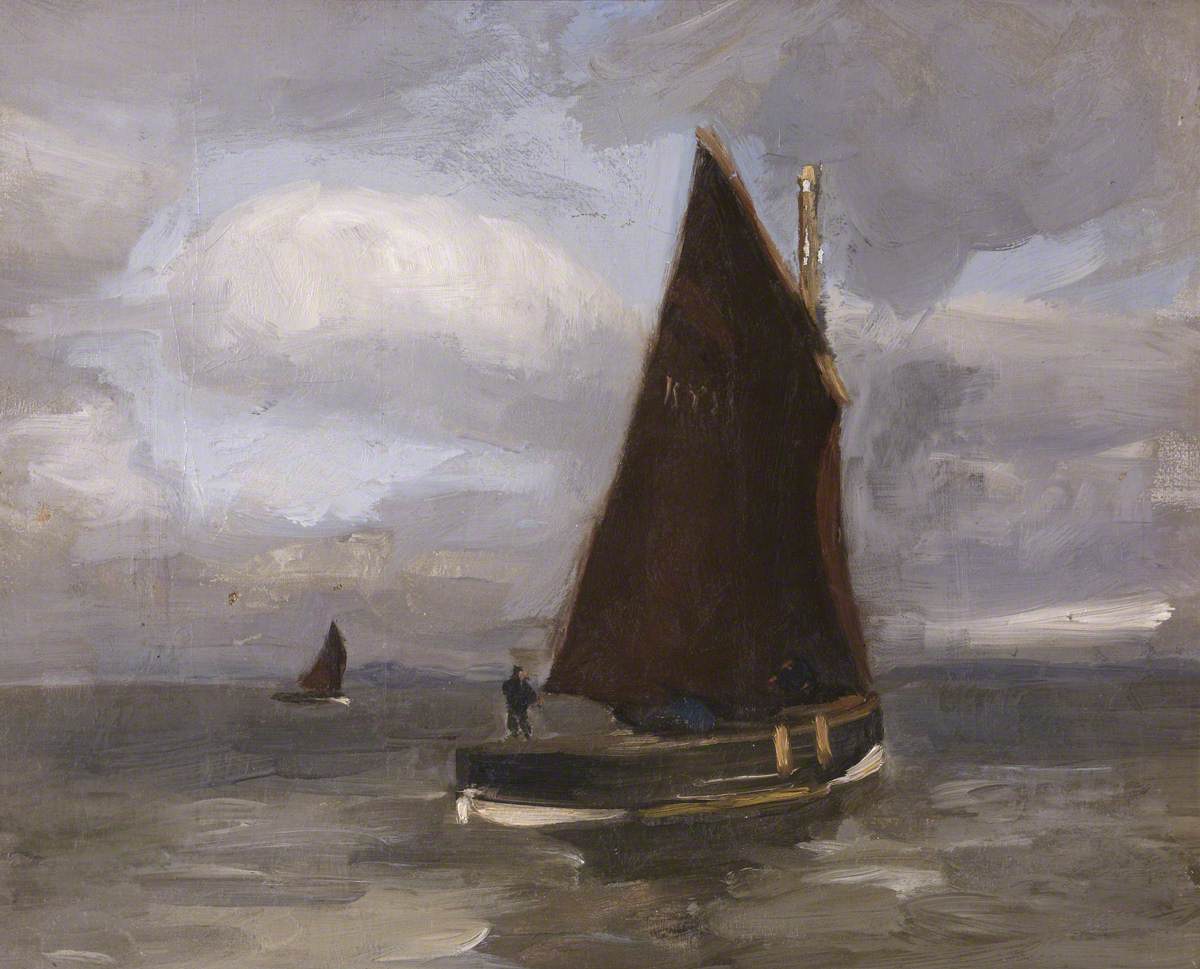
Couldn't quite find an attractive picture of a 17th century
dogger; something like this but larger.
A development of the ketch, a two-masted gaff-rigged vessel carrying a lug sail on the mizzen, with two jibs on a long bowsprit. Short and wide-beamed, these are employed primarily as fishing vessels (giving their name to “dogger bank.”). Sturdy, scores were sometimes grouped together and used in war defensive naval battles against much bigger ships.

Features a single forward cabin with hardpoint on the bow.

Yare: C
Dimensions: length (45 ft.); beam (18 ft.); keel to cabin roof (17 ft.)
Strength: hull (15 pts.); rigging (8 pts.)
Hardpoints: forward (1)
Draft: 2 ft.
Staterooms: quarters (1); decks (1½)
Cargo: 20 tons
Crew: 11
Construction Time: 1 month

See Also,
Hardpoints
Naval Combat
Ship Types
Wind Effects on Movement

Ketch

Includes the crayer and similar to the yawl, a two-masted ocean-going fishing boat with a large fore-and-aft sail on the mainmast, which is taller than the mizzen. To assist going windward, a ketch will usually carry at least one foresail such as a jib or genoa. Some ketches will give a +1 movement bonus when reaching or running with the wind.

Yare: B
Dimensions: length (75 ft.); beam (18 ft.); keel to poop (38 ft.)
Strength: hull (30 pts.); rigging (8 pts.)
Hardpoints: amidships (4)
Draft: 8 ft.
Staterooms: quarters (2); berths (2); decks (3)
Cargo: 77 tons
Crew: 14
Construction Time: 7 months

Knarr

Also called the snaika, a ship built for long sea voyages. Wider, deeper and shorter than a Viking longship, these supplanted old ships as trade became more important to Scandinavia than raiding. Popular in northern Europe. Though dangerous, these ships are used to carry stores to Iceland, Greenland and Vinland, as well as trading goods with the British Isles and the Mediterranean.

The boat is covered with heavy skins stretched over a deep hull where cargo is stored. In heavy weather, waves will break over the top of the ship while it remains seaworthy.

Yare: C
Dimensions: length (50 ft.); beam (15 ft.); keel to prow (12 ft.)
Strength: hull (17 pts.); rigging (4 pts.)
Hardpoints: none
Draft: 2 ft.
Staterooms: quarters (1); decks (1)
Cargo: 13 tons
Crew: 8
Construction Time: 3 weeks

See Also,
Naval Combat
Ship Types
Wind Effects on Movement

Junk

Describes the most common type of junk used by independent merchants in Eastern Asia. This sailing ship employs fully battened sails and has been continuously in use since ancient times. Built of teak from Guangdong, the multiple internal compartments and bulkheads are accessed by separate hatches and ladders, reminiscent of the internal structure of bamboo.

The hull has a horseshoe-shaped stern supporting a high poop deck. Seagoing junks incorporate a keel for sea travel (it is unreliable as an ocean-going vessel), but the river junk has no keel and relies on a daggerboard, leeboard or very large rudder to prevent the boat from slipping sideways in the water.

Junks employ stern mounted rudders; this allows height adjustment of the rudder to the depth of the water and reduces damage should the junk ground. The rudder is fenestrated with large diamond-shaped holes, adopted to lessen the force needed to direct the steering of the rudder. It is usually made of elm.

River Junk
Yare: B
Dimensions: length (70 ft.); beam (19 ft.); keel to poop (22 ft.)
Strength: hull (23 pts.); rigging (11 pts.)
Hardpoints: forward (2); stern (2); amidships (1)
Draft: 1½ ft.
Staterooms: quarters (1); decks (2)
Cargo: 19 tons
Crew: 16
Construction Time: 33 days

Sea-going Junk
Yare: C
Dimensions: length (75 ft.); beam (20 ft.); keel to poop (34 ft.)
Strength: hull (25 pts.); rigging (12 pts.)
Hardpoints: forward (2); stern (2); amidships (2)
Draft: 4 ft.
Staterooms: quarters (1); decks (3)
Cargo: 35 tons
Crew: 17
Construction Time: 2 months

See Also,
Hardpoints
Naval Combat
Ship Types
Wind Effects on Movement

Carrack

A tall three-masted ocean-going ship developed from the cog, large enough to be stable in heavy seas, for a large cargo and for the provisions needed for very long voyages. Carracks are square-rigged on the foremast and mainmast, while being lateen-rigged on the mizzenmast.

They have a high rounded stern with large stern castle, with a slightly shorter forecastle. The stern castle is often stepped, with a lower fore and a higher aft. The height of the ship is part of its superiority, as it is difficult to board once grappled.

The Indian Carrack describes ships used by the English, French, Dutch and Portuguese to round the Horn of Africa to trade with the Far East.

Common Carrack

Yare: C
Dimensions: length (115 ft.); beam (27 ft.); keel to stern castle (49 ft.)
Strength: hull (45 pts.); rigging (12 pts.)
Hardpoints: forward (4); stern (6); amidships (2)
Draft: 9 ft.
Staterooms: captain (1); quarters (3); berths (3); decks (4½)
Cargo: 360 tons
Crew: 21
Construction Time: 13 months

Indian Carrack

Yare: C
Dimensions: length (196 ft.); beam (46 ft.); keel to stern castle (83 ft.)
Strength: hull (77 pts.); rigging (20 pts.)
Hardpoints: forward (6); stern (10); amidships (4)
Draft: 16 ft.
Staterooms: captain (1); quarters (8); berths (21); decks (7½)
Cargo: 1,763 tons
Crew: 63
Construction Time: 3½ years

See Also,
Hardpoints
Naval Combat
Ship Types
Wind Effects on Movement

Monday, March 4, 2019

Dekares

An immense cataphracted galley primarily designed to deliver a contingent of marines into a battle, as space for hundreds of marines is available upon the uppermost deck as well as below. The hardpoints amidships are often used for siege towers up to 20 feet high, allowing bowmen to rain fire on enemy decks while defended. The bow and stern are further defended by castles.

Type: heavy galley
Dimensions: length (150 ft.); beam (40 ft.); keel upper deck (43 ft.)
Strength: hull (135 pts.); rigging (8)
Hardpoints: forward (5); stern (5); amidships (14)
Draft: 6 ft.
Staterooms: captain (1); officer quarters (7); berths (13); decks (3½)
Cargo: 318 tons
Crew: crew (22); oarsmen (176)
Construction Time: 2 years

See Also,
Hardpoints
Naval Combat
Ship Types
Wind Effects on Movement

Cog

A broad, single-masted vessel with square rigging, high sides and a relatively flat bottom, stable enough to be sea-going but not safe for ocean journeys. The ship has a small castle both fore and aft. These ships are common in the Baltic Sea, where sufficient but controlled winds enable good navigation, while the hull is strengthened against sea ice. They are less practical in the Mediterranean, where the winds are not as strong much of the year or against the heavy winter seas.

Small Cog

Yare: D
Dimensions: length (75 ft.); beam (25 ft.); keel to forecastle (33 ft.)
Strength: hull (35 pts.); rigging (4 pts.)
Hardpoints: forward (2); stern (2); amidships (1)
Draft: 4 ft.
Staterooms: captain (1); quarters (1); berths (2); decks (3)
Cargo: 96 tons
Crew: 11
Construction Time: 2½ months

Large Cog

Yare: E
Dimensions: length (93 ft.); beam (31 ft.); keel to forecastle (40 ft.)
Strength: hull (43 pts.); rigging (5 pts.)
Hardpoints: forward (2); stern (3); amidships (4)
Draft: 5½ ft.
Staterooms: captain (1); quarters (3); berths (3); decks (4)
Cargo: 183 tons
Crew: 14
Construction Time: 5 months

See Also,
Hardpoints
Naval Combat
Ship Types
Wind Effects on Movement

Coaster

A light coastal vessel based on the cog, commonly designed to deliver goods around a single island or along a coast, poorly-designed for sea travel and impractical as an ocean-going ship.

Coasters are common ships in the Mediterranean but are rarely seen elsewhere.

Yare: D
Dimensions: length (50 ft.); beam (15 ft.); keel to forecastle (27 ft.)
Strength: hull (23 pts.); rigging (6 pts.)
Hardpoints: forward (1)
Draft: 4 ft.
Staterooms: captain (1); berths (1); decks (3)
Cargo: 49 tons
Crew: 11
Construction Time: 34 days

See Also,
Hardpoints
Naval Combat
Ship Types
Wind Effects on Movement

Caravel

A small, highly manoeuvrable ocean-going ship, able to outdistance many larger vessels. The lateen sail gave it speed and the capacity for beating to windward, and are most popular with Portuguese and Castilians for the oceanic journey across the Atlantic. Typically they are fitted with two masts.

Having a shallow keel and being smaller than many cargo vessels, the caravel can sail upriver in shallow coastal waters. Its economy, speed, agility and power makes it esteemed as one of the best sailing vessels. It will outdistance pirates in heavier ships. The limited capacity for cargo and crew (many of whom have to sleep on deck) is its main drawback.

Yare: B
Dimensions: length (76 ft.); beam (20 ft.); keel to forecastle (35 ft.)
Strength: hull (30 pts.); rigging (8 pts.)
Hardpoints: forward (2); stern (1); amidships (2)
Draft: 5 ft.
Staterooms: captain (1); quarters (1); berths (2); decks (3)
Cargo: 105 tons
Crew: 14
Construction Time: 2½ months

Bireme

An oared galley with two decks of oars, with high speed and a shallow draft. These were equipped with a single masted fore-and-aft rigged square sail, to supplement the oarsmen in favourable winds. Because it can be beached, there was no need for a ship’s launch. The principal value in a galley is that the ship itself is the weapon, as it can be used to ram.

The bireme is not cataphracted, which means it does not have an upper deck. Covering in weather is provided by framing and canvas; the boat is beached at night for resting.

Type: light galley
Dimensions: length (80 ft.); beam (15 ft.); keel to upper deck (23 ft.)
Strength: hull (36 pts.); rigging (4)
Hardpoints: forward (2); stern (2); amidships (7)
Draft: 2 ft.
Staterooms: captain (1); officer berth (1); decks (3)
Cargo: 43 tons
Crew: crew (12); oarsmen (88)
Construction Time: 6½ months.

See Also,
Hardpoints
Naval Combat
Ship Types
Wind Effects on Movement

Barge (river vessel)

Common river vessels using the river’s current to float downstream with heavy loads covered by canvas. A low sleeping house is usually located amidship or near the stern, suitable for two persons comfortably or four cramped. Downstream, four polemen handle the craft, but a minimum compliment of oarsmen are needed for bringing the empty barge upstream. A half-full barge pulled upstream requires a full complement of oarsmen.

Scow (Light Barge)

Dimensions: length (60 ft.); beam (8 ft.); keel to house roof (11 ft.)
Strength: hull (20 pts.)
Hardpoints: none
Draft: 1 ft.
Staterooms: quarters (1); decks (1)
Cargo: 20 tons
Crew: polemen (4); oarsmen (8/20)
Construction Time: 2 weeks

Heavy Barge

Dimensions: length (80 ft.); beam (11 ft.); keel to house roof (15 ft.)
Strength: hull (27 pts.)
Hardpoints: none
Draft: 16 in.
Staterooms: quarters (1); berths (1); decks (1)
Cargo: 50 tons
Crew: polemen (5); oarsmen (10/26)
Construction Time: 33 days

Royal Barge

Special in that it will be ornately carved, rowed by soldiers and mercenaries, and fitted with an upper deck, forward, that will be heavily fortified. Typically, most of the weight carried will be temporary roofing, furnishings, additional servants or slaves, possibly treasure and also weapons.

Dimensions: length (100 ft.); beam (13 ft.); keel to house roof (23 ft.)
Strength: hull (34 pts.)
Hardpoints: forward (1)
Draft: 20 in.
Staterooms: chamber (4); servants’ berths (10); decks (2)
Cargo: 122 tons
Crew: polemen (7); oarsmen/marines (33)
Construction Time: 5½ months

See Also,
Hardpoints
Naval Combat
Ship Types
Wind Effects on Movement

Sunday, March 3, 2019

Holk

A kind of sea craft, the technological predecessor of the carrack and caravel. The ship is essentially a very large cog. Combining minimal lateen sails with two square-rigged masts, the holk is predominantly a cargo vessel used for low grade raw materials such as grains, stone, common foodstuffs, beverages and raw fibres.

Because of its relative speed, holks are built with two castles, one at the bow and one at the stern, for defence. A seagoing vessel, it is not safe for ocean journeys. These ships rarely travel alone and are usually attended by smaller, more nimble convoy minders. Convoys of these ships are more common than single vessels.

Yare: E
Dimensions: length (110 ft.); beam (29 ft.); keel to forecastle (37 ft.)
Strength: hull (44 pts.); rigging (12 pts.)
Hardpoints: foreward (2); stern (2); amidships (6)
Draft: 7 ft.
Staterooms: captain (1); quarters (5); berths (8); decks (3)
Cargo: 394 tons
Crew: 21
Construction Time: 88 days

See Also,
Hardpoints
Naval Combat
Ship Types
Wind Effects on Movement

Saturday, March 2, 2019

Simultaneous Movement

The simultaneous movement table has been designed so that a creature with 10 action points (AP) per round would have the ability to move normally across one combat hex in each of ten SEGMENTS. As a round is 12 seconds long, each segment lasts 1.2 seconds. A normal humanoid moves at 5 AP.

Ships in combat, using the wind effects table, move anywhere from zero to seven ship hexes in that same amount of time. As an example, a ship moving seven ship hexes per round would move over water at the same speed that a creature with 7 AP would move over seven combat hexes. This way, ship movement and creature movement can both be resolved at the same time.

Numbers indicate the order of actions as determined by logged movement,
or the number of AP used to that point.

When moving ships that may interact with each other or collide, the fastest ship moving for each segment always has initiative, so that ships are moved upwards through each column.

Normally, D&D combat is carried out in turns, overlooking the irrationality of one side moving while the other stands still.  In naval combat, where the distances moved by ships is so great, we adopt simultaneous movement for the ships only so that opportunities for attacking with ship's weapons and missile troops are preserved.  It is not intended for individual combat to be likewise regulated by simultaneous movement.

When determining the actions of normal combatants, whether with ship's weapons, missiles or in melee, those with initiative (see boarding) are considered to move between segments 1 to 5, while those without initiative should move between segments 6 to 10.  This should be reset occasionally (compressing time for ordinary combatants as necessary) so that the integrity of the ship's movement remains stable, which may even change the order of initiative.

Take note that, if required, D&D combat could be carried out simultaneously, if that were needed at a particular moment during the naval combat.  In such a case, the creature with initiative who finished their AP attack cost in a given segment would roll to hit first.

See Also,
Movement Execution
Naval Combat

Collisions (naval combat)

Both friendly and enemy ships that strike each other at the point of contact within a single combat hex, inside a ship hex, are considered to have collided with each other. This is determined according to rules under simultaneous movement.

If the collisions is in passing, sufficient to argue that the ships might have missed each other by inches, they can be allowed to pass on their way after the collision ~ but a roll must be made to see if the ships have fouled.

If fouling has occurred, then it is considered a full collision and both ships must cease movement at that point. The ships should NOT be shifted or moved to “straighten the up” to the ship hexes, but should be left precisely where the hit occurred.

Where one ship is considerably larger than the other, than an optional rule can be applied that the larger ship will drag the smaller one combat hex per 60 tons displacement difference between the two ships.

All remaining logged movement is voided. No hull damage occurs during collisions.

See Also,
Naval Combat
Ship Types

Movement Execution (naval combat)

Once everyone has written their log notations and those have been revealed, the movement of all ships on the map is resolved simultaneously, with their movement factors incrementally applied during the round. This will mean that as ship’s weapons are fired; as missile troops loose arrows and crossbows from the decks; as grappling and ungrappling is attempted; and as boarding and melee take place, ships will also be in motion upon the battle map.

To regulate this motion, the simultaneous movement table is used.

Where collisions occur, the ships must be checked for fouling. Note that if a collision occurs, the remaining log notation is voided.

See Naval Combat


Friday, March 1, 2019

Anchor (dropping & lifting)

During the movement notation phase, players may decide to anchor their ships when logging movement. However, anchoring does not go into effect the round of noting it in the log, but rather the following round. The log should indicate the ship’s movement prior to anchoring … and then that next round, the ship MUST stop at anchor. No last minute decision to the contrary can be made.

To drop anchor effectively, the depth of the water cannot be more than 60 feet. The type of anchoring may be designated: ships may be anchored by the bow or by the stern. When dropping anchor, the usual order is written “DP,” for drop anchor. Anchored ships may not move or turn in place.

Anchoring provides a +1 bonus to hit for all ship’s weapons. This bonus is not provided if the ship is in the process of lifting the anchor.

If the move is notated, “LP,” or lift anchor, the crew will begin to lift the anchor of the ship that round. To completely lift the anchor will take 6 full rounds; however, after 2 complete rounds, half the crew may be assigned to man the ship and get it moving. During these four rounds, the crew is not permitted to turn the ship, back the sail or take part in grappling, unfouling, or boarding. Should the crew be forced to do so, the anchor will run out and the ship should again be considered anchored. The anchor can be dropped again in this fashion at any time.

A ship can cut its anchors, which must also be recorded ahead of time when logging movement. It requires two rounds to cut an anchor free from a ship, after which, the ship may move normally. Once a ship has cut its anchors, it cannot be anchored again.

See Naval Combat

Drifting (naval combat)

Ships that have ceased to move under their own power, due to damage to the hull or rigging, the lack of a crew, or that cannot move due to grappling, fouling or ramming, or even the lack of orders, will drift. When ships drift, they do so with their attitude to the wind unchanged.

If the bow of a ship does not change its position for two consecutive movement execution phases, then during the second phase the ship will drift 1 combat hex per wind speed, plus the full drift distance described on the wind effects table for ship types (applied to yares A to C). This drift will be in the direction the wind is blowing. This drift should be spaced out during simultaneous movement.

Ships that are fouled or grappled together cannot move or turn in place, so they must drift.

Ships that have lost all their rigging points (becoming dismasted) will also drift. Dismasted ships may turn in place 60-degree every three full rounds of drifting.

During the movement notation phase, each ship that is drifting can be written in the log as “D” for drifting. A note of drifting should always be made.

Drifting will stop once a ship has voluntarily moved one ship hex.

See Naval Combat

Backing Sail (naval combat)

A maneuver which holds back the movement of the ship during the movement execution phase by the crew pushing the boom to windward, applying the force of the wind upon the opposite sail surface. This is a difficult maneuver, requiring strength and crew coordination, one demanding a crew quality of no less than average.

Captains that wish to order a ship to hold back so that it can move forward at a precise moment (important for avoiding a collision), should, when logging movement, indicate which factors of the ship’s movement allowance will be used to back the sail.

For example, a ship with 5 factors might wish to move only two hexes forward, but to do so either late or early in the round, rather than have that movement spaced evenly from the beginning of the round to the end (see simultaneous movement). Thus, the captain would indicate in the log, using a “B” for backing the sail and an “A” for moving ahead, as A-A-B-B-B, whereas the normal distribution during the round for those two forward movement (without backing the sail), would be (using “O” for not moving), O-O-A-O-A.

It can be difficult to see the usefulness of the manouevre without a complete familiarity of the rules and the manner in which the ships will be moving continuously around each other during the combat round, but captains with experience are sure to find occasions where backing the sail will be necessary.

See Naval Combat